
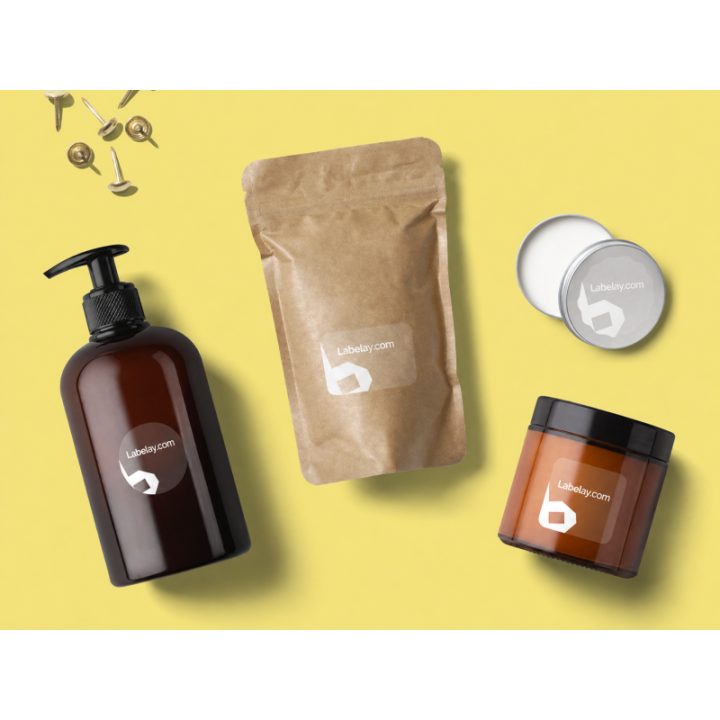
“Waterproof label” is one of the most common phrases people use when they really mean several different things. One product may only need to survive an occasional splash. Another sits in a refrigerator and develops condensation every day. A beverage bottle might spend hours in an ice bucket. A bathroom product can be handled repeatedly with wet hands. Those situations are not equivalent, so the same label construction should not be assumed to perform identically in all of them.
The useful question is not simply “Is this label waterproof?” It is: What kind of moisture exposure will this package experience, for how long, and on what surface?
Water-resistant and waterproof are not the same requirement
In everyday packaging language, “water-resistant” usually describes a label that can tolerate ordinary moisture, splashes or brief contact without immediately breaking down. “Waterproof” is often used more broadly by shoppers, but it can imply a much harsher condition such as prolonged wet exposure or immersion.
For a brand owner, the distinction matters because label performance depends on the complete construction: face material, print, finish, adhesive, container surface and application conditions. A film face material may resist water better than an unprotected paper face, but that alone does not guarantee that every label on every container will survive indefinite immersion.
If your use case is unusually demanding, describe it clearly when ordering. For special environments, the safest route is to request a custom quote and include the container material and expected exposure.
Start with film when moisture is part of normal use
When condensation, splashes or wet handling are expected, film labels are generally the more practical starting point than paper. Film does not absorb moisture in the same way an uncoated paper face can, which is why materials such as white film labels and clear film labels are commonly considered for bottles, jars, cosmetics and other packages that may encounter moisture.
That does not mean paper is a poor material. Paper can be an excellent choice for dry-use products where texture, tactility and a natural appearance matter more than moisture resistance. Our Paper Labels page shows the kind of visual direction paper supports, while the Material Guide helps compare it with film and specialty materials.
Condensation creates a different challenge from a splash
A quick splash may contact the face of a label and disappear. Condensation can behave differently because moisture repeatedly forms across the package, including around label edges. Cold bottles and refrigerated jars can cycle between dry and wet conditions as they move between storage and room temperature.
This is why beverage packaging should be evaluated under the conditions customers will actually experience. If a bottle will be chilled, let a sample package reach that temperature. If it will sit in an ice bucket, test that scenario. A label that looks perfect when applied to a clean room-temperature bottle has not yet demonstrated how it will behave under repeated moisture.
The container surface is just as important as the label face
Adhesion happens between the label adhesive and the surface of the package. Glass, PET, HDPE, coated containers and textured surfaces can present different conditions. Even two containers that look similar can have different surface characteristics.
Before application, the surface should be clean and dry. Oil, dust, condensation or residue can reduce the amount of direct adhesive contact. Applying a label to a bottle that is already cold and wet is not the same as applying it to a clean, dry bottle and allowing the bond to establish before refrigeration.
Curves matter too. A label wrapped tightly around a small-diameter container experiences more stress than the same label on a broad, flat panel. Very small jars, tapered bottles and compound curves deserve extra attention during testing.
Clear or white film for bottles?
Once film is the likely material family, the next decision is often visual. White film creates an opaque background and usually gives printed artwork more separation from the product inside the bottle. Clear film lets the container show through and can create a minimal “printed-on-the-bottle” appearance.
The design consequences are significant. On clear material, the liquid or container color can influence how artwork appears. Light colors may need white ink to remain visible. If you are deciding between the two, read Clear vs White Labels: How to Choose the Right Material for Your Packaging.
Finish can influence real-world appearance
Gloss and matte finishes change more than the mood of the package. They also affect how the surface reflects light, how fingerprints are noticed and how the label visually interacts with moisture. A glossy label on a cold bottle can look bright and saturated, while a matte surface may feel more understated.
Neither finish eliminates the need to test the complete package. If moisture is a key part of the use case, design and durability should be evaluated together rather than treating finish as a purely decorative choice.
Do not ignore the label edges
Most packaging mockups focus on the center of the artwork. Real-world durability problems often begin at edges: a corner gets picked during handling, moisture repeatedly reaches the perimeter, or the label is placed across a surface transition.
Give the label enough flat, stable contact area whenever the container allows it. Avoid placing critical edges directly over seams, aggressive curves or areas that are frequently rubbed by caps, holders or packaging equipment.
A practical testing checklist
Before committing to a large production quantity for a moisture-exposed product, recreate the conditions that matter to your customer:
- Apply to the same bottle, jar or container material used in production.
- Make sure the surface is clean and dry during application.
- Allow the applied label to settle before exposing the package to demanding conditions.
- Test refrigeration and condensation if the product will be chilled.
- Test repeated wet handling if the product is used in a bathroom, kitchen or similar environment.
- Watch the edges as well as the printed face.
- Evaluate legibility after exposure, not just whether the label remains attached.
When “waterproof” is a mission-critical claim
If failure would create a regulatory, safety or operational problem, do not rely on a generic material description alone. The exact package, environment and performance requirement need to be considered. Tell us whether the package will be refrigerated, immersed, exposed to oils or cleaners, used outdoors, or handled under other demanding conditions.
Standard product labels can cover a wide range of everyday packaging, but unusual applications deserve a more specific conversation. Use Request a Quote for those projects.
Build the label around the actual use case
For most brands, the best starting point is straightforward: choose a label material that matches the expected environment, apply it correctly to the real container, and test the package under realistic conditions before scaling the order.
If your bottles and jars mainly face occasional splashes or normal condensation, compare the specifications available for White Labels and Clear Labels. Once you know the size, quantity, shape and finish you want, you can use Get an Instant Price to build the actual order rather than estimating from a generic label type.
Turn the guide into a real specification.
Choose your material, size, shape, finish and quantity, then see the price before checkout.